
AU Small Finance Bank's Zenith+ is a metal, super-premium credit card that competes directly with cards from India's largest banks on lounge access and forex markup, without requiring you to hold an AU Bank account first. Here's what it actually costs, who qualifies, and where it genuinely beats — and loses to — the bigger-bank alternatives.
AU Bank Zenith+ eligibility and fees
| Requirement | Detail |
|---|---|
| Age (primary) | 18–65 years |
| Age (add-on) | 18 years and above |
| Minimum income (salaried) | Net monthly income above ₹25,000 |
| Minimum income (self-employed) | ₹6,00,000 annual income |
| AU Bank account required? | No — issued on income/CIBIL profile, not a banking relationship |
| Joining fee | ₹4,999 + GST |
| Annual fee | ₹4,999 + GST, waived from year 2 on ₹8,00,000 net retail spend in the prior year |
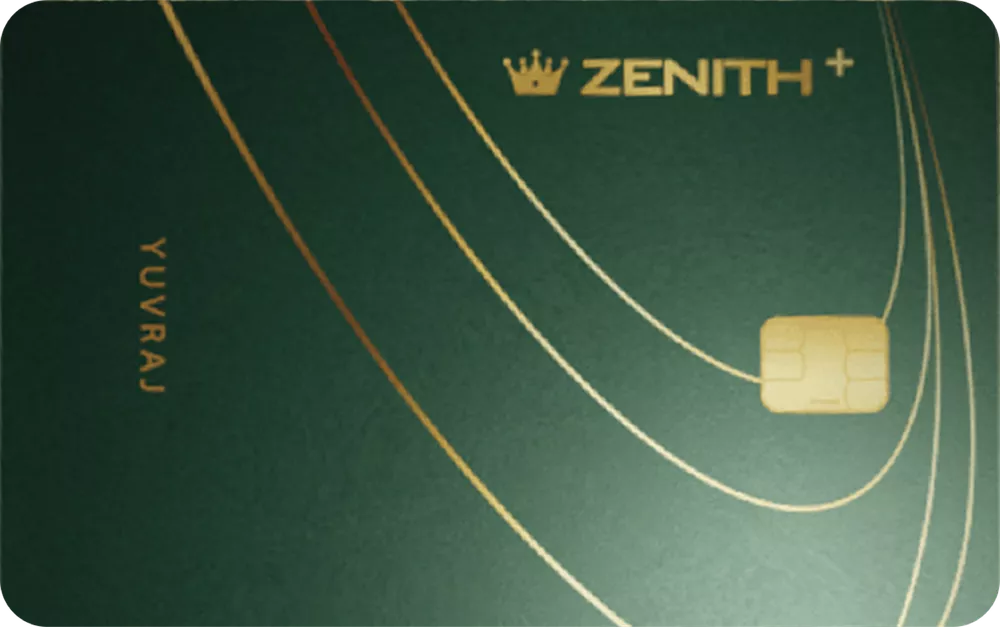
AU Bank Zenith+ Credit Card
annual fee
joining fee
reward rate
min income
What the card actually rewards
Zenith+ earns 1 reward point per ₹100 on standard spends, and effectively the same rate (2 points per ₹200) on dining, travel, and international transactions — so unlike some premium cards, there's no dramatic multiplier for travel-heavy spenders. Each point redeems at ₹1, keeping the math simple. New cardholders get a welcome benefit worth ₹5,000, redeemable as a luxury brand voucher or equivalent points, on activation.
The forex markup is the real headline number
At 0.99%, Zenith+'s forex markup undercuts most premium cards from India's largest banks, where 2-3.5% is typical (Axis Magnus, for comparison, charges 2%). If you travel internationally often and put meaningful spend on your card abroad, this single number can be worth more over a year than the reward-point differences between competing premium cards.
Lounge access and lifestyle perks
Zenith+ offers 16 complimentary domestic lounge visits per year (4 per quarter) and 16 complimentary international lounge visits per year via Priority Pass (also 4 per quarter) — plus 4 complimentary airport meet-and-assist services annually. On the lifestyle side, cardholders get up to 16 buy-one-get-one movie or event tickets on BookMyShow per year, and a complimentary Taj Epicure membership once a spending milestone is reached.
How it stacks up against bigger-bank premium cards
| Card | Annual fee | Min. income | Forex markup | Lounge access |
|---|---|---|---|---|
| AU Zenith+ | ₹4,999+GST (waivable at ₹8L spend) | ₹25,000/month salaried | 0.99% | 16 domestic + 16 intl/year |
| Axis Magnus | ₹12,500+GST (waivable at ₹25L spend) | ₹24L/year salaried | 2% | Unlimited (₹50K/quarter spend needed) |
| HDFC Regalia Gold | ₹2,500+GST (waivable at ₹5L spend) | ₹1L/month salaried | 2% | 12/year (6 domestic + 6 intl) |
The comparison makes AU Zenith+'s real position clear: it asks for a far lower income than Axis Magnus while matching or beating it on forex and lounge count — but its reward-earning rate doesn't scale up for big spenders the way Magnus's tiered structure does. It's the stronger pick for someone who travels often on a moderate income; Magnus wins for someone who can genuinely spend ₹1.5 lakh+ a month and wants the reward rate to climb with it.
How to apply, and what documents you'll need
You can apply for Zenith+ directly through AU Small Finance Bank's website or a branch — no prior AU Bank relationship required. Salaried applicants need PAN, the last 3 months' payslips, Form 16 or 6 months of salary-account statements, and standard address proof (Aadhaar, passport, or a recent utility bill). Self-employed applicants need 2 years of ITR filings showing income above ₹6,00,000, along with bank statements for the same period. Because the card is issued on income and CIBIL profile rather than an existing account relationship, approval turnaround tends to be faster than cards that require you to open a savings account first.
Zenith+ vs the plain Zenith card
AU Bank also issues a non-"Plus" Zenith card, positioned a tier below. The core difference is the lounge allotment and welcome benefit — Zenith+'s 16+16 annual lounge visits and ₹5,000 welcome voucher are richer than the base Zenith card's benefits, at a correspondingly higher joining/annual fee. If your main draw is the aggressive 0.99% forex markup and you don't travel often enough to use 16+ lounge visits a year, it's worth checking the base Zenith card's current terms before defaulting to the Plus variant.
Key takeaways
- Zenith+'s income bar (₹25,000/month salaried, ₹6L/year self-employed) is dramatically lower than most metal super-premium cards, and it needs no AU Bank account relationship.
- The 0.99% forex markup is genuinely best-in-class — half of what most bank-issued premium cards charge.
- 16 domestic + 16 international lounge visits a year (4/quarter each) is a strong, no-catch benefit — no minimum quarterly spend gate, unlike some competitors.
- Reward earning is flat (effectively 1%) across categories — it doesn't reward high spenders with a better rate the way Axis Magnus's tiered structure does.
- The ₹4,999+GST fee fully waives from year 2 onward once you clear ₹8 lakh net retail spend in the prior year.
Frequently Asked Questions
Do I need an AU Small Finance Bank account to get Zenith+?
No. The card is issued based on your income and CIBIL profile, not an existing banking relationship with AU Bank.
Is the joining fee refundable or waivable on approval?
No — the ₹4,999+GST joining fee applies at issuance regardless of spend. Only the annual (renewal) fee from year 2 onward is waivable, and only if you clear ₹8 lakh net retail spend in the preceding year.
How does Zenith+'s lounge access compare to Axis Magnus's "unlimited" access?
Zenith+ gives a fixed 16 domestic + 16 international visits a year with no ongoing spend requirement. Magnus offers unlimited visits, but only stays active if you spend at least ₹50,000 in the previous quarter — for lower or irregular spenders, Zenith+'s fixed allotment can end up being the more reliable benefit.
What counts toward the ₹8 lakh fee-waiver spend threshold?
"Net retail spend" typically excludes categories like fuel, rent payments via third-party apps, wallet loads, and cash-equivalent transactions — check the current terms on AU Bank's own card page before assuming a specific spend category counts.
Does self-employed income need to be shown via ITR?
Yes — self-employed applicants generally need to demonstrate the ₹6,00,000 annual income threshold through ITR filings and supporting bank statements, similar to most premium card applications.
EMI Calculator
Calculate your credit card EMI conversion
- Convert large purchases into easy EMIs
- Compare tenure options (3, 6, 9, 12 months)
- See total interest you'll pay upfront