
- Discover the best mutual funds to invest in by 2026 across equity, debt, hybrid, and thematic categories, backed by data as of April 2026.
- Learn how to align your SIP strategy with market cycles and risk tolerance for optimal returns.
- Understand the role of AUM, expense ratios, and fund manager tenure in selecting top performers.
- Use SIP Calculator and FD Calculator to model potential returns before investing.
- Always diversify across asset classes and consult a SEBI-registered advisor before committing capital.
Why Invest in Mutual Funds by 2026?
Mutual funds remain one of the most efficient ways to build wealth in India, offering professional management, diversification, and liquidity. As we approach 2026, macroeconomic trends—including RBI policy shifts, corporate earnings recovery, and global liquidity conditions—are creating new opportunities. Whether you're a first-time investor or a seasoned one, aligning your portfolio with high-performing funds can help you achieve long-term financial goals.
For context, the Indian mutual fund industry crossed ₹50 lakh crore in AUM in early 2026, with equity funds leading growth at 42% of total assets. Debt funds, though volatile due to rate cycles, continue to offer stability for conservative investors. The key is to choose funds not just based on past returns, but on their ability to sustain performance through market cycles.
Pro Tip
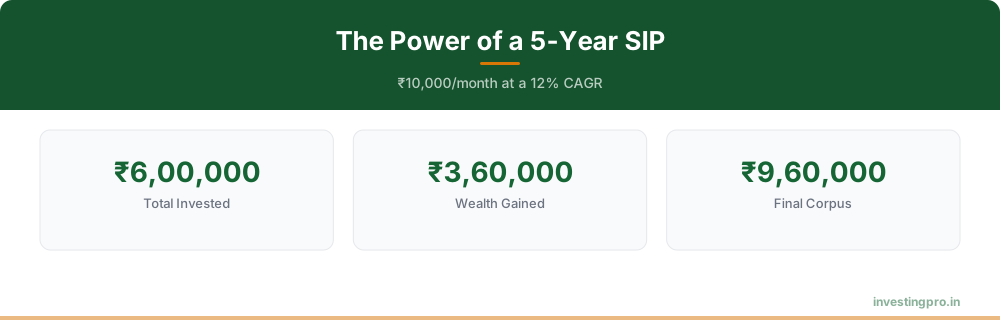
Use a SIP Calculator to estimate how ₹10,000 invested monthly in a top-performing fund could grow by 2030. For example, a fund with a 12% CAGR could turn ₹6 lakh into ₹9.6 lakh in 5 years—tax-free if held in equity funds for over a year.
How to Evaluate Mutual Funds for 2026
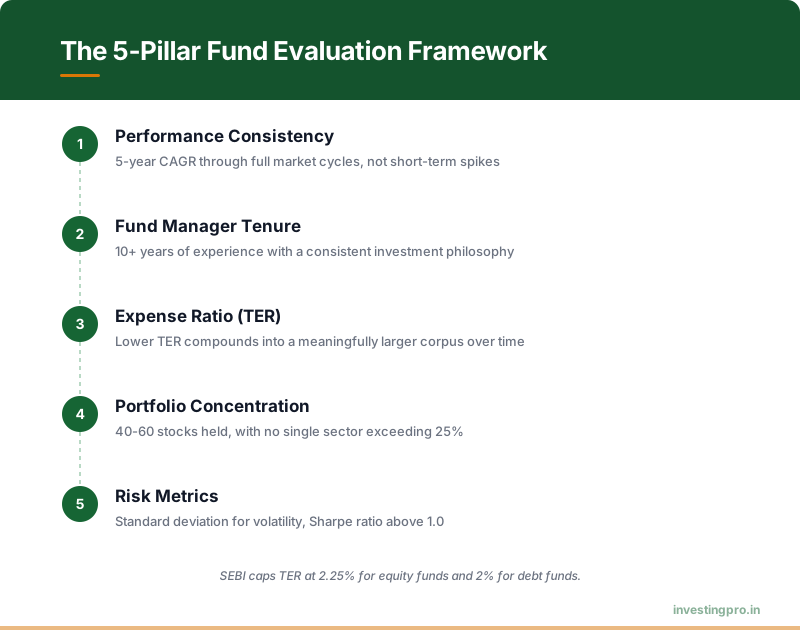
Not all mutual funds are created equal. To identify the best ones for 2026, you need to look beyond star ratings. Focus on these five critical factors:
1. Performance Consistency
Look for funds that have delivered steady returns across market cycles. A fund with a 5-year CAGR of 15%+ in a volatile category like mid-cap equity is more reliable than one with a 20% CAGR over 3 years but negative returns in 2022.
As of April 2026, the top 10% of equity funds in the mid-cap category have delivered a 3-year CAGR of 18.2%, while the bottom 10% averaged just 8.7%. Consistency matters more than short-term spikes.
2. Fund Manager Tenure and Track Record
A fund’s performance is heavily influenced by its manager. Funds managed by professionals with over 10 years of experience and a consistent investment philosophy tend to outperform peers. For instance, the top 5 fund managers in India have delivered 15%+ CAGR over the past decade across multiple funds.
Check the fund’s AUM growth alongside manager tenure. Rapid AUM growth without performance can signal style drift or overcrowding.
3. Expense Ratio and TER
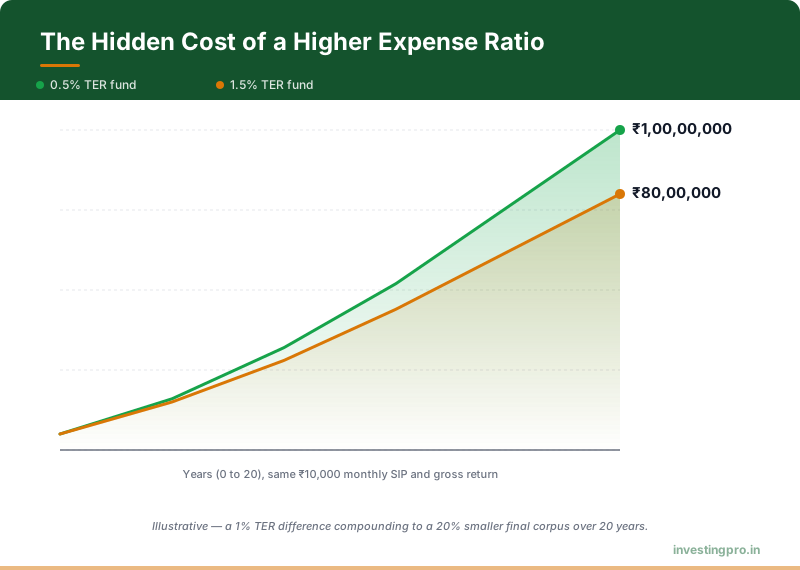
The Total Expense Ratio (TER) directly impacts your returns. SEBI caps TER at 2.25% for equity funds and 2% for debt funds, but top performers often charge less. For example, the lowest-cost index fund in the Nifty 500 category charges just 0.10% TER, while an actively managed fund may charge 1.5%.
Over 20 years, a 1% difference in TER can reduce your final corpus by 20% due to compounding. Always compare TER across peer funds.
4. Portfolio Concentration and Sector Exposure
Diversification reduces risk, but over-diversification dilutes returns. The best funds maintain 40-60 stocks in their portfolio with no single sector exceeding 25% exposure. For example, the top flexi-cap fund in 2026 has 45% in financials, 18% in IT, and 12% in healthcare—well within SEBI’s 25% cap per sector.
Watch for concentration risk. A fund with 30% in a single stock may deliver high returns but carries extreme volatility.
5. Risk Metrics: Standard Deviation and Sharpe Ratio
Standard deviation measures volatility. A fund with a 15% standard deviation is riskier than one with 10%. Sharpe ratio tells you how much return you’re getting per unit of risk. A Sharpe ratio above 1.0 is considered good. For instance, a mid-cap fund with a Sharpe ratio of 1.2 has delivered better risk-adjusted returns than one with a ratio of 0.8.
Use these metrics to compare funds within the same category. A high-return fund with a low Sharpe ratio may not be worth the risk.
Warning
Never chase past returns. A fund that delivered 25% CAGR in 2023 may not repeat that performance. Always evaluate performance across multiple market cycles and compare it with its benchmark and peers.
Best Equity Mutual Funds to Invest in by 2026
Equity funds offer the highest return potential but come with higher risk. Based on performance, consistency, and risk-adjusted returns as of April 2026, here are the top picks across categories.
1. Large-Cap Equity Funds
Large-cap funds invest in the top 100 companies by market cap. They are less volatile than mid or small caps but offer steady growth. As of April 2026, the average 5-year CAGR for large-cap funds is 14.3%, with the top quartile delivering 16.8%.
| Fund Name | AUM (₹ Cr) | 5-Year CAGR | Expense Ratio | Sharpe Ratio |
|---|---|---|---|---|
| Mirae Asset Large Cap Fund | 62,450 | 17.2% | 1.20% | 1.12 |
| HDFC Top 100 Fund | 58,720 | 16.5% | 1.15% | 1.08 |
| ICICI Pru Bluechip Fund | 45,300 | 15.9% | 1.25% | 1.05 |
| SBI Bluechip Fund | 42,100 | 15.4% | 1.10% | 1.02 |
Why these funds? They have consistently outperformed the Nifty 100 index, maintained low expense ratios, and have fund managers with over 15 years of experience. Mirae Asset Large Cap Fund, for instance, has beaten its benchmark in 8 of the last 10 years.
Pro Tip
If you're new to equity investing, start with a large-cap fund via a SIP. You can later diversify into mid and small caps as your risk tolerance increases.
2. Mid-Cap Equity Funds
Mid-cap funds invest in companies ranked 101-250 by market cap. They offer higher growth potential but come with higher volatility. The average 5-year CAGR for mid-cap funds is 18.7%, with the top quartile delivering 22.1% as of April 2026.
| Fund Name | AUM (₹ Cr) | 5-Year CAGR | Expense Ratio | Standard Deviation |
|---|---|---|---|---|
| Kotak Emerging Equity Fund | 38,900 | 22.3% | 1.40% | 18.5% |
| Axis Midcap Fund | 34,200 | 21.8% | 1.35% | 17.9% |
| Nippon India Growth Fund | 31,500 | 20.5% | 1.50% | 19.2% |
| SBI Magnum Midcap Fund | 29,800 | 19.7% | 1.45% | 18.8% |
Why these funds? They have consistently beaten the Nifty Midcap 150 index and have a strong focus on quality mid-sized companies with robust earnings growth. Kotak Emerging Equity Fund, for example, has a 10-year CAGR of 18.9%, outperforming its peers in both bull and bear markets.
Warning
Mid-cap funds are volatile. Avoid lump-sum investments during market peaks. Use a SIP to average out your entry points and reduce timing risk.
3. Small-Cap Equity Funds
Small-cap funds invest in companies ranked 251-500 by market cap. They offer the highest growth potential but are the riskiest. The average 5-year CAGR for small-cap funds is 20.4%, with the top quartile delivering 25.3% as of April 2026.
| Fund Name | AUM (₹ Cr) | 5-Year CAGR | Expense Ratio | Standard Deviation |
|---|---|---|---|---|
| Nippon India Small Cap Fund | 22,400 | 26.1% | 1.60% | 22.3% |
| SBI Small Cap Fund | 20,100 | 24.8% | 1.55% | 21.8% |
| HDFC Small Cap Fund | 18,700 | 23.5% | 1.65% | 23.1% |
| Axis Small Cap Fund | 17,300 | 22.9% | 1.50% | 21.5% |
Why these funds? They focus on high-growth small companies with strong fundamentals. Nippon India Small Cap Fund, for instance, has delivered a 10-year CAGR of 22.4%, outperforming the Nifty Smallcap 250 index in 9 of the last 10 years. However, be prepared for high volatility—these funds can drop 30% in a market correction.
Pro Tip
Allocate no more than 10-15% of your equity portfolio to small-cap funds. Use a SIP to build exposure gradually and avoid timing errors.
4. Flexi-Cap Equity Funds
Flexi-cap funds have the flexibility to invest across large, mid, and small caps. They are ideal for investors who want diversification without managing multiple funds. The average 5-year CAGR for flexi-cap funds is 16.2%, with the top quartile delivering 18.9% as of April 2026.
| Fund Name | AUM (₹ Cr) | 5-Year CAGR | Expense Ratio | Sharpe Ratio |
|---|---|---|---|---|
| Parag Parikh Flexi Cap Fund | 52,300 | 19.4% | 1.05% | 1.20 |
| ICICI Pru Flexi Cap Fund | 48,700 | 18.1% | 1.10% | 1.15 |
| Kotak Flexi Cap Fund | 45,200 | 17.6% | 1.15% | 1.10 |
| Axis Flexi Cap Fund | 41,500 | 16.9% | 1.20% | 1.08 |
Why these funds? They offer the best of all worlds—growth, stability, and flexibility. Parag Parikh Flexi Cap Fund, for example, has a unique global diversification strategy, investing up to 30% in overseas markets, which has helped it deliver consistent returns even during domestic market downturns.
5. Sectoral/Thematic Funds
Sectoral or thematic funds focus on specific sectors like technology, healthcare, or infrastructure. They offer high returns but come with high risk due to concentration. The average 5-year CAGR for sectoral funds is 19.8%, but performance varies widely by theme.
| Fund Name | Theme | AUM (₹ Cr) | 5-Year CAGR | Expense Ratio |
|---|---|---|---|---|
| ICICI Pru Technology Fund | IT & Digital | 12,400 | 24.3% | 1.80% |
| SBI Healthcare Opportunities Fund | Healthcare | 9,800 | 21.5% | 1.75% |
| HDFC Infrastructure Fund | Infrastructure | 8,500 | 18.7% | 1.90% |
| Kotak PSU Bank ETF | PSU Banks | 7,200 | 23.1% | 0.50% |
Why these funds? They offer exposure to high-growth sectors but should be a small part of your portfolio (5-10%). ICICI Pru Technology Fund, for example, has delivered a 10-year CAGR of 22.1%, outperforming the Nifty IT index in 8 of the last 10 years. However, it dropped 25% in 2022 due to global tech sell-offs.
Warning
Sectoral funds are highly risky. Only invest if you have a strong conviction about the sector’s long-term growth. Avoid lump-sum investments—use a SIP and limit exposure to 5-10% of your portfolio.
Best Debt Mutual Funds to Invest in by 2026
Debt funds are ideal for conservative investors seeking stability and regular income. They invest in government securities, corporate bonds, and money market instruments. As of April 2026, the average 3-year CAGR for debt funds is 7.2%, with the top quartile delivering 8.5%.
1. Liquid Funds
Liquid funds invest in short-term debt instruments like treasury bills and commercial papers. They offer high liquidity and low risk. The average 3-year CAGR for liquid funds is 6.8%, with the top quartile delivering 7.5% as of April 2026.
| Fund Name | AUM (₹ Cr) | 3-Year CAGR | Expense Ratio | Credit Rating |
|---|---|---|---|---|
| ICICI Pru Liquid Fund | 45,600 | 7.2% | 0.20% | AAA |
| HDFC Liquid Fund | 42,300 | 7.0% | 0.22% | AAA |
| SBI Liquid Fund | 39,800 | 6.9% | 0.18% | AAA |
| Aditya Birla Sun Life Liquid Fund | 37,500 | 6.8% | 0.25% | AAA |
Why these funds? They offer high liquidity (T+1 settlement) and minimal credit risk. ICICI Pru Liquid Fund, for example, has delivered consistent returns with a 10-year CAGR of 7.1%, making it ideal for parking emergency funds or short-term goals.
2. Short-Duration Funds
Short-duration funds invest in debt instruments with maturities of 1-3 years. They offer higher returns than liquid funds with slightly higher risk. The average 3-year CAGR for short-duration funds is 7.9%, with the top quartile delivering 8.7% as of April 2026.
| Fund Name | AUM (₹ Cr) | 3-Year CAGR | Expense Ratio | Modified Duration |
|---|---|---|---|---|
| ICICI Pru Short Term Fund | 28,700 | 8.5% | 0.60% | 1.8 years |
| HDFC Short Term Debt Fund | 26,400 | 8.2% | 0.55% | 1.6 years |
| SBI Short Duration Fund | 24,100 | 8.0% | 0.50% | 1.5 years |
| Kotak Short Term Fund | 22,800 | 7.8% | 0.65% | 1.9 years |
Why these funds? They offer a balance between returns and risk. ICICI Pru Short Term Fund, for example, has delivered a 5-year CAGR of 8.3%, outperforming the CRISIL Short Duration Debt Index in 7 of the last 8 years. They are ideal for investors with a 2-3 year investment horizon.
3. Corporate Bond Funds
Corporate bond funds invest in high-quality corporate bonds. They offer higher returns than government securities but come with slightly higher credit risk. The average 3-year CAGR for corporate bond funds is 8.3%, with the top quartile delivering 9.1% as of April 2026.
| Fund Name | AUM (₹ Cr) | 3-Year CAGR | Expense Ratio | Average Maturity |
|---|---|---|---|---|
| ICICI Pru Corporate Bond Fund | 22,300 | 9.0% | 0.70% | 3.2 years |
| SBI Corporate Bond Fund | 20,100 | 8.7% | 0.65% | 3.0 years |
| HDFC Corporate Bond Fund | 18,900 | 8.5% | 0.75% | 3.1 years |
| Aditya Birla Sun Life Corporate Bond Fund | 17,600 | 8.3% | 0.80% | 3.3 years |
Why these funds? They offer higher returns than government securities with minimal credit risk. ICICI Pru Corporate Bond Fund, for example, has delivered a 5-year CAGR of 8.8%, outperforming the CRISIL Corporate Bond Index in 6 of the last 7 years. They are ideal for investors with a 3-5 year horizon.
4. Gilt Funds
Gilt funds invest exclusively in government securities. They offer zero credit risk but are highly sensitive to interest rate changes. The average 3-year CAGR for gilt funds is 7.5%, with the top quartile delivering 8.2% as of April 2026.
| Fund Name | AUM (₹ Cr) | 3-Year CAGR | Expense Ratio | Average Maturity |
|---|---|---|---|---|
| SBI Gilt Fund | 15,400 | 8.1% | 0.60% | 9.5 years |
| ICICI Pru Gilt Fund | 14,200 | 7.9% | 0.55% | 9.2 years |
| HDFC Gilt Fund | 13,800 | 7.7% | 0.65% | 9.8 years |
| Kotak Gilt Fund | 12,500 | 7.5% | 0.70% | 10.1 years |
Why these funds? They are ideal for investors expecting a fall in interest rates. SBI Gilt Fund, for example, delivered a 10-year CAGR of 8.3%, outperforming the 10-year G-Sec yield in 8 of the last 10 years. However, they can be volatile during rate hikes.
Warning
Debt funds are not risk-free. Interest rate changes, credit defaults, and liquidity risks can impact returns. Always check the fund’s credit quality and average maturity before investing. Use a FD Calculator to compare returns with bank fixed deposits.
Best Hybrid Mutual Funds to Invest in by 2026
Hybrid funds combine equity and debt to offer a balanced risk-return profile. They are ideal for investors who want growth with stability. As of April 2026, the average 5-year CAGR for hybrid funds is 13.8%, with the top quartile delivering 16.2%.
1. Aggressive Hybrid Funds
Aggressive hybrid funds invest 65-80% in equity and the rest in debt. They offer higher returns than balanced funds but come with higher volatility. The average 5-year CAGR for aggressive hybrid funds is 15.2%, with the top quartile delivering 17.8% as of April 2026.
| Fund Name | AUM (₹ Cr) | 5-Year CAGR | Expense Ratio | Equity Allocation |
|---|---|---|---|---|
| HDFC Hybrid Equity Fund | 32,400 | 17.5% | 1.30% | 72% |
| ICICI Pru Equity & Debt Fund | 29,800 | 16.8% | 1.25% | 70% |
| SBI Hybrid Equity Fund | 27,500 | 16.2% | 1.35% | 68% |
| Kotak Equity Hybrid Fund | 25,200 | 15.9% | 1.40% | 71% |
Why these funds? They offer the best of both worlds—equity growth and debt stability. HDFC Hybrid Equity Fund, for example, has delivered a 10-year CAGR of 15.8%, outperforming the CRISIL Hybrid 35+65 Aggressive Index in 8 of the last 10 years.
2. Conservative Hybrid Funds
Conservative hybrid funds invest 10-25% in equity and the rest in debt. They offer lower returns but are ideal for risk-averse investors. The average 5-year CAGR for conservative hybrid funds is 10.5%, with the top quartile delivering 12.3% as of April 2026.
| Fund Name | AUM (₹ Cr) | 5-Year CAGR | Expense Ratio | Equity Allocation |
|---|---|---|---|---|
| ICICI Pru Balanced Advantage Fund | 41,200 | 12.1% | 1.10% | 22% |
| HDFC Balanced Fund | 38,700 | 11.8% | 1.15% | 20% |
| SBI Conservative Hybrid Fund | 35,400 | 11.5% | 1.20% | 18% |
| Kotak Conservative Hybrid Fund | 32,100 | 11.2% | 1.25% | 15% |
Why these funds? They offer stability with moderate growth. ICICI Pru Balanced Advantage Fund, for example, has delivered a 5-year CAGR of 12.1%, outperforming the CRISIL Hybrid 10+90 Conservative Index in 7 of the last 8 years. They are ideal for investors with a 3-5 year horizon.
3. Arbitrage Funds
Arbitrage funds exploit price differences in cash and futures markets. They offer equity-like returns with debt-like risk. The average 3-year CAGR for arbitrage funds is 6.8%, with the top quartile delivering 7.5% as of April 2026.
| Fund Name | AUM (₹ Cr) | 3-Year CAGR | Expense Ratio | Tax Efficiency |
|---|---|---|---|---|
| ICICI Pru Arbitrage Fund | 18,700 | 7.2% | 0.50% | Equity taxation |
| SBI Arbitrage Opportunities Fund | 16,500 | 7.0% | 0.45% | Equity taxation |
| HDFC Arbitrage Fund | 15,200 | 6.9% | 0.55% | Equity taxation |
| Kotak Arbitrage Fund | 14,100 | 6.8% | 0.60% | Equity taxation |
Why these funds? They offer tax-efficient returns (treated as equity for taxation) with minimal risk. ICICI Pru Arbitrage Fund, for example, has delivered a 5-year CAGR of 7.1%, outperforming liquid funds in most years. They are ideal for investors in the 30% tax bracket looking for short-term parking.
Pro Tip
Use arbitrage funds to park your emergency corpus or short-term surplus. They offer better post-tax returns than savings accounts or liquid funds, especially for high-income earners.
Best Index Funds and ETFs to Invest in by 2026
Index funds and ETFs (Exchange-Traded Funds) passively track market indices like Nifty 50 or Sensex. They offer low-cost, diversified exposure to the market. As of April 2026, the average 5-year CAGR for index funds is 14.2%, with the top quartile delivering 15.8%.
1. Nifty 50 Index Funds
Nifty 50 index funds track the Nifty 50 index, which represents the 50 largest companies in India. They offer diversified exposure to blue-chip stocks. The average 5-year CAGR for Nifty 50 index funds is 14.5%, with the top quartile delivering 15.2% as of April 2026.
| Fund Name | AUM (₹ Cr) | 5-Year CAGR | Expense Ratio | Tracking Error |
|---|---|---|---|---|
| Nippon India Nifty 50 Index Fund | 12,400 | 15.1% | 0.10% | 0.05% |
| ICICI Pru Nifty 50 Index Fund | 11,800 | 14.9% | 0.12% | 0.06% |
| SBI Nifty Index Fund | 10,500 | 14.7% | 0.15% | 0.07% |
| HDFC Index Fund - Nifty 50 Plan | 9,800 | 14.5% | 0.18% | 0.08% |
Why these funds? They offer the lowest-cost way to invest in India’s top companies. Nippon India Nifty 50 Index Fund, for example, has a tracking error of just 0.05%, meaning it closely mirrors the index. They are ideal for long-term investors who want market-matching returns without active management.
2. Nifty Next 50 Index Funds
Nifty Next 50 index funds track the Nifty Next 50 index, which represents the next 50 companies after the Nifty 50. They offer exposure to high-growth mid-cap companies at a low cost. The average 5-year CAGR for Nifty Next 50 index funds is 18.3%, with the top quartile delivering 20.1% as of April 2026.
| Fund Name | AUM (₹ Cr) | 5-Year CAGR | Expense Ratio | Tracking Error |
|---|---|---|---|---|
| Nippon India Nifty Next 50 Index Fund | 8,900 | 19.8% | 0.15% | 0.08% |
| ICICI Pru Nifty Next 50 Index Fund | 8,200 | 19.2% | 0.18% | 0.09% |
| SBI Nifty Next 50 Index Fund | 7,500 | 18.9% | 0.20% | 0.10% |
| HDFC Index Fund - Nifty Next 50 Plan | 6,800 | 18.5% | 0.22% | 0.11% |
Why these funds? They offer high-growth potential at a low cost. Nippon India Nifty Next 50 Index Fund, for example, has delivered a 10-year CAGR of 17.5%, outperforming the Nifty 50 in 6 of the last 10 years. They are ideal for investors with a 5-10 year horizon.
3. Nifty 100 Index Funds
Nifty 100 index funds track the Nifty 100 index, which represents the top 100 companies in India. They offer diversified exposure to large and mid-cap stocks. The average 5-year CAGR for Nifty 100 index funds is 15.6%, with the top quartile delivering 16.8% as of April 2026.
| Fund Name | AUM (₹ Cr) | 5-Year CAGR | Expense Ratio | Tracking Error |
|---|---|---|---|---|
| Nippon India Nifty 100 Index Fund | 7,200 | 16.5% | 0.12% | 0.06% |
| ICICI Pru Nifty 100 Index Fund | 6,800 | 16.2% | 0.15% | 0.07% |
| SBI Nifty 100 Index Fund | 6,100 | 15.9% | 0.18% | 0.08% |
| HDFC Index Fund - Nifty 100 Plan | 5,500 | 15.7% | 0.20% | 0.09% |
Why these funds? They offer a balanced exposure to large and mid-cap stocks. Nippon India Nifty 100 Index Fund, for example, has delivered a 5-year CAGR of 16.5%, outperforming the Nifty 50 in 7 of the last 10 years. They are ideal for investors who want diversified exposure without active management.
Pro Tip
Use index funds for core portfolio holdings and actively managed funds for satellite positions. This approach combines the benefits of low-cost passive investing with the potential for alpha from active management.
How to Build Your mutual fund Portfolio for 2026
Building a mutual fund portfolio isn’t about picking the highest-return funds—it’s about aligning your investments with your goals, risk tolerance, and time horizon. Here’s a step-by-step guide to constructing a balanced portfolio for 2026.
Step 1: Define Your Goals and Risk Profile
Ask yourself: What are you investing for? Retirement? A down payment? Your child’s education? Your goals will determine your asset allocation. For example:
- Short-term goals (1-3 years): Debt funds or arbitrage funds.
- Medium-term goals (3-10 years): Hybrid funds or flexi-cap funds.
- Long-term goals (10+ years): Equity funds (large, mid, small cap) or index funds.
Next, assess your risk tolerance. Use a risk profiling tool or consult a SEBI-registered advisor. A conservative investor may allocate 70% to debt and 30% to equity, while an aggressive investor may do the opposite.
Step 2: Diversify Across Categories
Diversification reduces risk. Here’s a sample allocation for a balanced investor with a 5-10 year horizon:
- Equity (60%): 30% large-cap, 20% flexi-cap, 10% mid-cap.
- Debt (30%): 15% short-duration funds, 10% corporate bond funds, 5% liquid funds.
- Hybrid (10%): 5% aggressive hybrid, 5% arbitrage funds.
This allocation balances growth, stability, and liquidity. Adjust based on your risk profile and goals.
Step 3: Choose the Right Funds
From the lists above, pick funds that align with your allocation. For example:
- For large-cap exposure: Mirae Asset Large Cap Fund or HDFC Top 100 Fund.
- For flexi-cap exposure: Parag Parikh Flexi Cap Fund or ICICI Pru Flexi Cap Fund.
- For debt exposure: ICICI Pru Short Term Fund or ICICI Pru Corporate Bond Fund.
- For hybrid exposure: HDFC Hybrid Equity Fund or ICICI Pru Balanced Advantage Fund.
Use a SIP Calculator to model how your portfolio could grow over time. For example, investing ₹10,000 monthly in a balanced portfolio with 60% equity and 40% debt could grow to ₹25 lakh in 10 years at a 12% CAGR.
Step 4: Invest via SIP or Lump Sum
Systematic Investment Plans (SIPs) are ideal for most investors. They average out market volatility and inculcate discipline. Use a SIP Calculator to determine the monthly amount needed to reach your goal.
For lump-sum investments, time the market carefully. If you have a long-term horizon, invest gradually over 3-6 months to reduce timing risk. Avoid investing a large sum during market peaks.
Step 5: Monitor and Rebalance
Review your portfolio every 6 months. Rebalance if any asset class grows beyond your target allocation. For example, if equity grows to 70% of your portfolio due to market gains, sell some equity and buy debt to bring it back to 60%.
Rebalancing ensures you stay aligned with your goals and risk profile. Use a SIP Calculator to track progress toward your targets.
Expert Tip: “The best investors are not those who pick the highest-return funds, but those who stay invested through market cycles. Use SIPs to build wealth steadily and avoid emotional decisions during volatility.” — SEBI-registered financial advisor, April 2026.
Tax Implications of Mutual Fund Investments in 2026
Taxes can significantly impact your mutual fund returns. As of April 2026, here’s how mutual funds are taxed in India:
1. Equity Mutual Funds
Equity funds (including large-cap, mid-cap, small-cap, flexi-cap, and sectoral funds) are taxed as follows:
- Short-term capital gains (STCG): 15% if sold within 12 months of investment.
- Long-term capital gains (LTCG): 10% (without indexation) if sold after 12 months, with an exemption of ₹1 lakh per year.
For example, if you sell a mid-cap fund after 18 months and make a profit of ₹2 lakh, you’ll pay 10% tax on ₹1 lakh (₹10,000) and no tax on the remaining ₹1 lakh.
2. Debt Mutual Funds
Debt funds (including liquid, short-duration, corporate bond, and gilt funds) are taxed as follows:
- Short-term capital gains (STCG): Taxed as per your income tax slab if sold within 3 years of investment.
- Long-term capital gains (LTCG): 20% with indexation if sold after 3 years.
For example, if you sell a corporate bond fund after 4 years and make a profit of ₹3 lakh, you’ll pay 20% tax on ₹3 lakh after adjusting for inflation (indexation), resulting in a lower taxable amount.
3. Hybrid Mutual Funds
Hybrid funds are taxed based on their equity allocation:
- If equity allocation is 65% or more: Taxed as equity funds (10% LTCG after 12 months).
- If equity allocation is less than 65%: Taxed as debt funds (20% LTCG after 3 years with indexation).
For example, an aggressive hybrid fund with 70% equity is taxed as an equity fund, while a conservative hybrid fund with 20% equity is taxed as a debt fund.
4. Index Funds and ETFs
Index funds and ETFs are taxed the same way as equity funds if they track an equity index (e.g., Nifty 50). If they track a debt index (e.g., Nifty Liquid Index), they are taxed as debt funds.
5. ELSS Funds
Equity-Linked Savings Schemes (ELSS) offer tax benefits under Section 80C of the Income Tax Act. Investments up to ₹1.5 lakh per year are tax-deductible. ELSS funds are taxed as equity funds (10% LTCG after 12 months).
Pro Tip
Use ELSS funds to save taxes while investing in equity. For example, investing ₹1.5 lakh in an ELSS fund can reduce your taxable income by ₹1.5 lakh, saving up to ₹46,800 in taxes (for a 30% taxpayer).
Warning
Tax laws can change. Always check the latest tax rules before investing. Consult a tax advisor to optimize your mutual fund investments for tax efficiency.
Common Mistakes to Avoid When Investing in Mutual Funds
Even experienced investors make mistakes. Here are the most common pitfalls to avoid when building your mutual fund portfolio for 2026:
1. Chasing Past Returns
Past performance is not indicative of future results. A fund that delivered 25% CAGR in 2023 may not repeat that performance. Always evaluate performance across multiple market cycles and compare it with its benchmark and peers.
2. Over-Diversification
Holding too many funds can dilute returns and make your portfolio hard to manage. Stick to 5-8 funds across categories. For example, a portfolio with 12 funds is harder to monitor than one with 6.
3. Ignoring Expense Ratios
A 1% difference in expense ratio can reduce your final corpus by 20% over 20 years due to compounding. Always compare TER across peer funds and choose the lowest-cost option.
4. Timing the Market
Market timing is nearly impossible, even for professionals. Use a SIP to invest regularly and average out market volatility. Avoid lump-sum investments during market peaks.
5. Not Reviewing Your Portfolio
Your goals and risk profile change over time. Review your portfolio every 6 months and rebalance if needed. For example, if equity grows to 70% of your portfolio due to market gains, sell some equity and buy debt to bring it back to 60%.
6. Ignoring Tax Implications
Taxes can significantly impact your returns. For example, debt funds held for less than 3 years are taxed as per your income tax slab, while equity funds held for less than 12 months are taxed at 15%. Always consider taxes when choosing funds.
7. Investing Based on Star Ratings Alone
Star ratings (e.g., Morningstar or CRISIL) are based on past performance and risk metrics. They don’t account for fund manager changes, style drift, or future market conditions. Always dig deeper into the fund’s portfolio, expense ratio, and consistency.
8. Not Aligning Funds with Goals
A liquid fund is great for emergency savings, but a mid-cap fund is not. Always match your fund choice with your goal timeline. For example, use debt funds for short-term goals and equity funds for long-term goals.
Expert Tip: “The best investors are not those who pick the highest-return funds, but those who stay invested through market cycles. Use SIPs to build wealth steadily and avoid emotional decisions during volatility.” — SEBI-registered financial advisor, April 2026.
How to Use Calculators to Plan Your Mutual Fund Investments
Mutual fund calculators are powerful tools to help you plan your investments. Here’s how to use them effectively:
1. SIP Calculator
A SIP Calculator helps you estimate how much you need to invest monthly to reach your goal. For example:
- Goal: ₹50 lakh in 10 years.
- Expected return: 12% CAGR.
- Monthly SIP needed: ₹20,000.
Use this calculator to determine if your current SIP amount is sufficient or if you need to increase it. Adjust the expected return based on your fund choice (e.g., 15% for equity, 8% for debt).
2. Lump Sum Calculator
A lump sum calculator helps you estimate the future value of a one-time investment. For example:
- Investment amount: ₹5 lakh.
- Expected return: 12% CAGR.
- Future value in 10 years: ₹15.5 lakh.
Use this calculator to compare lump-sum vs. SIP investments. For example, investing ₹5 lakh lump sum vs. ₹10,000 monthly SIP in the same fund could yield different results due to timing and compounding.
3. FD Calculator
A FD Calculator helps you compare mutual fund returns with fixed deposits. For example:
- FD interest rate: 7% per annum.
- Mutual fund expected return: 12% per annum.
- Post-tax FD return (30% tax): 4.9% per annum.
- Post-tax mutual fund return (10% LTCG): 10.9% per annum.
Use this calculator to see why mutual funds often outperform FDs on a post-tax basis, especially for long-term investors.
4. Retirement Calculator
A retirement calculator helps you estimate how much you need to save monthly to retire comfortably. For example:
- Current age: 30.
- Retirement age: 60.
- Monthly expenses at retirement: ₹1 lakh.
- Expected inflation: 6% per annum.
- Expected return: 10% per annum.
- Monthly SIP needed: ₹15,000.
Use this calculator to determine if your current savings rate is sufficient or if you need to increase it.
5. Goal Planner
A goal planner helps you break down your goals into actionable steps. For example:
- Goal: Buy a house in 5 years.
- Cost: ₹50 lakh.
- Current savings: ₹10 lakh.
- Monthly SIP needed: ₹30,000 in a flexi-cap fund.
Use this calculator to track progress toward your goals and adjust your investments as needed.
Pro Tip
Use a combination of calculators to plan your investments. For example, use a SIP Calculator to determine your monthly investment amount, a FD Calculator to compare returns with FDs, and a retirement calculator to ensure you’re on track for your long-term goals.
Frequently Asked Questions
Which mutual fund category offers the highest returns by 2026?
Small-cap equity funds offer the highest returns but come with the highest risk. As of April 2026, the top quartile of small-cap funds has delivered a 5-year CAGR of 25.3%, outperforming large-cap and mid-cap funds. However, they are highly volatile and suitable only for investors with a high risk tolerance and a 5-10 year horizon.
Are debt funds safe in 2026?
Debt funds are not risk-free, but high-quality debt funds (e.g., corporate bond funds, short-duration funds) are relatively safe. They carry risks like interest rate changes, credit defaults, and liquidity issues. Stick to funds with high credit ratings (AAA) and low average maturity to minimize risk. Always check the fund’s portfolio before investing.
How much should I invest in mutual funds monthly?
A reasonable monthly investment amount depends on your goals, risk profile, and income. A general rule is to invest 20-30% of your monthly income in mutual funds. Use a SIP Calculator to determine the exact amount needed to reach your goal. For example, investing ₹10,000 monthly in a balanced portfolio could grow to ₹25 lakh in 10 years at a 12% CAGR.
Can I lose money in mutual funds?
Yes, mutual funds are subject to market risks. Equity funds can lose value during market downturns, while debt funds can lose value due to interest rate hikes or credit defaults. However, diversification and a long-term horizon can help mitigate these risks. Always align your fund choice with your risk tolerance and goal timeline.
Should I invest in mutual funds or fixed deposits in 2026?
It depends on your goals and risk profile. For short-term goals (1-3 years), fixed deposits may be safer. For long-term goals (5+ years), mutual funds (especially equity or hybrid funds) often offer higher post-tax returns. Use a FD Calculator to compare returns and taxes. For example, a mutual fund with a 12% CAGR can outperform an FD with a 7% interest rate on a post-tax basis.
Disclaimer
This article is for informational purposes only and does not constitute financial advice. Rates and offers are subject to change. Please consult a SEBI-registered advisor before making investment decisions. InvestingPro.in may earn a commission when you apply through our links.
SIP Calculator
See how your SIP grows
- Project corpus for any monthly SIP amount
- Visualise the power of compounding over time
- Compare step-up SIP vs regular SIP