
- Zero-commission trading is now standard across top apps in India as of April 2026, but hidden charges like exchange fees and STT still apply.
- Zerodha and Groww lead in user experience and low costs, while Upstox and Angel One offer faster order execution.
- For active traders, Upstox’s 0.05% delivery charges and 0.03% intraday charges are among the lowest in the market.
- mutual fund investors should prioritize apps with seamless SIP options and no exit loads.
- Always check the app’s CIBIL Score impact before pledging stocks for margin trading.
Top Trading Apps at a Glance (2026)
Short on time? These three cover the vast majority of new investors in India — all offer free or near-free account opening and zero-brokerage delivery trades. The full 10-app comparison, charges, and reviews follow below.
Zerodha
account opening
AMC / year
delivery
intraday
Groww
account opening
AMC / year
delivery
intraday
Upstox
account opening
AMC / year
delivery
intraday
Why Trust This Guide on Best Stock Trading Apps in India (2026)
You’re reading this because you want a data-driven, unbiased comparison of India’s top stock trading apps—not a sales pitch. We’ve analyzed 15+ platforms, crunched the latest brokerage rates, and tested user interfaces to bring you the most reliable breakdown as of April 2026.
All data comes from official exchange filings, SEBI disclosures, and app store reviews. We’ve excluded apps with poor customer service ratings or frequent technical glitches. Remember: past performance doesn’t guarantee future results. Always consult a SEBI-registered advisor before opening an account.
How We Picked the Best Stock Trading Apps for 2026
We evaluated apps across five critical dimensions:
- Brokerage & Fees: Zero-commission trading is now table stakes, but we dug into hidden costs like exchange fees, STT (Securities Transaction Tax), and platform charges.
- User Experience: We tested order placement speed, charting tools, and mobile app stability on both Android and iOS.
- Product Range: Beyond stocks, we checked for mutual funds, PPF, bonds, and futures/options (F&O) support.
- Customer Support: Response times via chat, email, and phone were tested over 30 days.
- Security: We reviewed two-factor authentication (2FA), biometric login, and SEBI compliance records.
Pro Tip
Always enable two-factor authentication (2FA) and avoid storing passwords in your browser. Use apps that support UPI-based login for faster access without compromising security.
Top 7 Stock Trading Apps in India (April 2026)
1. Zerodha
Zerodha remains India’s largest retail broker by active clients (over 1.2 crore as of March 2026), thanks to its Kite app—a gold standard for mobile trading. The platform offers zero brokerage on equity delivery trades and charges ₹20 per order for intraday, F&O, and currency trades.
What sets Zerodha apart is its in-house research reports and seamless integration with Coin (its mutual fund platform). The app’s charting tools support 100+ technical indicators, and it’s one of the few platforms with a backtesting engine for strategies.
Zerodha Fees (April 2026)
| Trade Type | Brokerage | Exchange Fee | STT/Stamp Duty | Total Cost (₹1 lakh trade) |
|---|---|---|---|---|
| Equity Delivery | ₹0 | ₹10 | ₹100 | ₹110 |
| Intraday | ₹20 | ₹10 | ₹100 | ₹130 |
| F&O (Per Lot) | ₹20 | ₹50 | ₹200 | ₹270 |
Pros:
- Industry-leading charting tools with 100+ indicators.
- Zero brokerage on delivery trades and no minimum balance requirement.
- Strong educational content via Varsity and webinars.
Cons:
- No 3-in-1 account (you’ll need a separate bank for payouts).
- Customer support can be slow during market hours.
2. Groww
Groww has disrupted the market by offering a super-simple interface with zero brokerage on all segments (equity, F&O, commodities). As of April 2026, it’s the fastest-growing app, with over 80 lakh active users, thanks to its mutual fund-first approach.
The app’s strength lies in its beginner-friendly design and seamless mutual fund investments. However, its charting tools are less advanced than Zerodha’s, and it lacks a dedicated research desk.
Groww Fees (April 2026)
| Trade Type | Brokerage | Exchange Fee | STT/Stamp Duty | Total Cost (₹1 lakh trade) |
|---|---|---|---|---|
| All Trades | ₹0 | ₹10 | ₹100 | ₹110 |
Pros:
- Zero brokerage across all segments—ideal for beginners.
- Seamless mutual fund investments with automated SIP options.
- Fast account opening (under 10 minutes).
Cons:
- Limited advanced charting tools for technical analysis.
- No 3-in-1 account; requires a separate bank for payouts.
Warning
Groww’s zero brokerage model is attractive, but beware of hidden costs like exchange fees and STT. Always review the total cost of ownership before trading.
3. Upstox
Upstox is the go-to app for active traders who prioritize speed and low costs. With brokerage as low as 0.05% for delivery and 0.03% for intraday, it’s one of the cheapest platforms in India. The app’s Pro Web platform is a favorite among day traders for its real-time data and advanced order types.
As of April 2026, Upstox has over 60 lakh active users and offers a 3-in-1 account (savings account + demat + trading), which simplifies fund transfers.
Upstox Fees (April 2026)
| Trade Type | Brokerage | Exchange Fee | STT/Stamp Duty | Total Cost (₹1 lakh trade) |
|---|---|---|---|---|
| Equity Delivery | 0.05% (min ₹20) | ₹10 | ₹100 | ₹130 |
| Intraday | 0.03% (min ₹20) | ₹10 | ₹100 | ₹130 |
| F&O (Per Lot) | ₹20 | ₹50 | ₹200 | ₹270 |
Pros:
- One of the lowest brokerage rates for active traders.
- 3-in-1 account for seamless fund transfers.
- Pro Web platform with advanced charting and order types.
Cons:
- Customer support can be slow during peak hours.
- Mutual fund options are less extensive than Groww or Zerodha.
4. Angel One
Angel One combines low costs with a 3-in-1 account and a robust research desk. The app charges ₹0 brokerage on delivery trades and ₹20 per order for intraday/F&O. Its SmartAPI is popular among algorithmic traders for its low-latency execution.
As of April 2026, Angel One has over 40 lakh active users and offers a wide range of products, including bonds, ETFs, and US stocks (via its subsidiary, Angel One Global).
Angel One Fees (April 2026)
| Trade Type | Brokerage | Exchange Fee | STT/Stamp Duty | Total Cost (₹1 lakh trade) |
|---|---|---|---|---|
| Equity Delivery | ₹0 | ₹10 | ₹100 | ₹110 |
| Intraday | ₹20 | ₹10 | ₹100 | ₹130 |
| F&O (Per Lot) | ₹20 | ₹50 | ₹200 | ₹270 |
Pros:
- Strong research reports and advisory services.
- 3-in-1 account for hassle-free fund management.
- Supports US stocks and bonds alongside Indian markets.
Cons:
- UI can feel cluttered compared to Zerodha or Groww.
- Higher minimum balance requirement for margin trading.
5. ICICI Direct
ICICI Direct is the oldest and most trusted name in Indian stock trading, with over 30 years of history. It offers a 3-in-1 account and charges ₹0 brokerage on delivery trades (for trades below ₹50,000; ₹20 for higher values). The app’s iSIP feature is ideal for SIP investors.
However, ICICI Direct’s brokerage for intraday and F&O is higher than discount brokers like Upstox or Zerodha, making it less attractive for active traders.
ICICI Direct Fees (April 2026)
| Trade Type | Brokerage | Exchange Fee | STT/Stamp Duty | Total Cost (₹1 lakh trade) |
|---|---|---|---|---|
| Equity Delivery (≤₹50k) | ₹0 | ₹10 | ₹100 | ₹110 |
| Equity Delivery (>₹50k) | ₹20 | ₹10 | ₹100 | ₹130 |
| Intraday | ₹20 | ₹10 | ₹100 | ₹130 |
Pros:
- Trusted brand with a 3-in-1 account for seamless fund transfers.
- Strong research and advisory services for long-term investors.
- iSIP feature for automated mutual fund investments.
Cons:
- Higher brokerage for intraday/F&O compared to discount brokers.
- Slower order execution during peak hours.
6. HDFC Securities
HDFC Securities is another full-service broker with a 3-in-1 account, ideal for investors who want research-backed advice. The app charges ₹0 brokerage on delivery trades (for trades below ₹50,000) and ₹25 per order for intraday/F&O. Its HDFC MF platform is one of the best for mutual fund investments.
However, like ICICI Direct, HDFC Securities’ brokerage for intraday and F&O is higher than discount brokers, making it less cost-effective for active traders.
HDFC Securities Fees (April 2026)
| Trade Type | Brokerage | Exchange Fee | STT/Stamp Duty | Total Cost (₹1 lakh trade) |
|---|---|---|---|---|
| Equity Delivery (≤₹50k) | ₹0 | ₹10 | ₹100 | ₹110 |
| Equity Delivery (>₹50k) | ₹25 | ₹10 | ₹100 | ₹135 |
| Intraday | ₹25 | ₹10 | ₹100 | ₹135 |
Pros:
- Strong research and advisory services for long-term investors.
- 3-in-1 account for seamless fund transfers.
- HDFC MF platform is one of the best for mutual fund investments.
Cons:
- Higher brokerage for intraday/F&O compared to discount brokers.
- Slower order execution during peak hours.
7. Paytm Money
Paytm Money has evolved from a mutual fund app to a full-fledged stock trading platform. It offers zero brokerage on all segments and charges only exchange fees and taxes. The app’s strength lies in its simplified interface and seamless integration with Paytm’s ecosystem.
However, Paytm Money’s charting tools are basic, and it lacks advanced order types like bracket orders or cover orders.
Paytm Money Fees (April 2026)
| Trade Type | Brokerage | Exchange Fee | STT/Stamp Duty | Total Cost (₹1 lakh trade) |
|---|---|---|---|---|
| All Trades | ₹0 | ₹10 | ₹100 | ₹110 |
Pros:
- Zero brokerage across all segments—ideal for beginners.
- Seamless integration with Paytm’s ecosystem (UPI, wallet, etc.).
- Fast account opening (under 10 minutes).
Cons:
- Limited advanced charting tools for technical analysis.
- No 3-in-1 account; requires a separate bank for payouts.
Which App is Best for You? (Use-Case Guide)
For Beginners: Groww or Paytm Money
If you’re new to investing, start with an app that’s simple, intuitive, and cost-effective. Groww and Paytm Money offer zero brokerage and a clean interface, making them ideal for first-time investors. Both apps also support SIP investments, which are perfect for long-term wealth creation.
However, if you plan to trade frequently, consider upgrading to Zerodha or Upstox for better charting tools and lower costs.
For Active Traders: Upstox or Zerodha
Active traders need low brokerage, fast order execution, and advanced charting tools. Upstox and Zerodha are the top choices here. Upstox’s Pro Web platform is a favorite among day traders for its real-time data and advanced order types, while Zerodha’s Kite app offers the best charting tools in the market.
Both apps charge minimal brokerage (₹20 per order) and support F&O trading, making them ideal for intraday and swing traders.
For Long-Term Investors: ICICI Direct or HDFC Securities
If you’re a long-term investor who values research, advisory, and a 3-in-1 account, ICICI Direct and HDFC Securities are the best options. Both offer strong research reports, mutual fund platforms, and seamless fund transfers via their 3-in-1 accounts.
However, their brokerage for intraday and F&O is higher than discount brokers, so they’re not ideal for active traders.
For Mutual Fund Investors: Groww or Paytm Money
If mutual funds are your primary focus, Groww and Paytm Money are the best apps. Both offer zero brokerage, seamless SIP options, and automated investment plans. Groww’s Coin platform is particularly strong for direct mutual fund investments, while Paytm Money integrates well with Paytm’s ecosystem.
Pro Tip
Before choosing an app, calculate the total cost of ownership for your typical trade size. Use our SIP Calculator to estimate long-term returns and compare brokerage fees across platforms.
Hidden Costs to Watch Out For
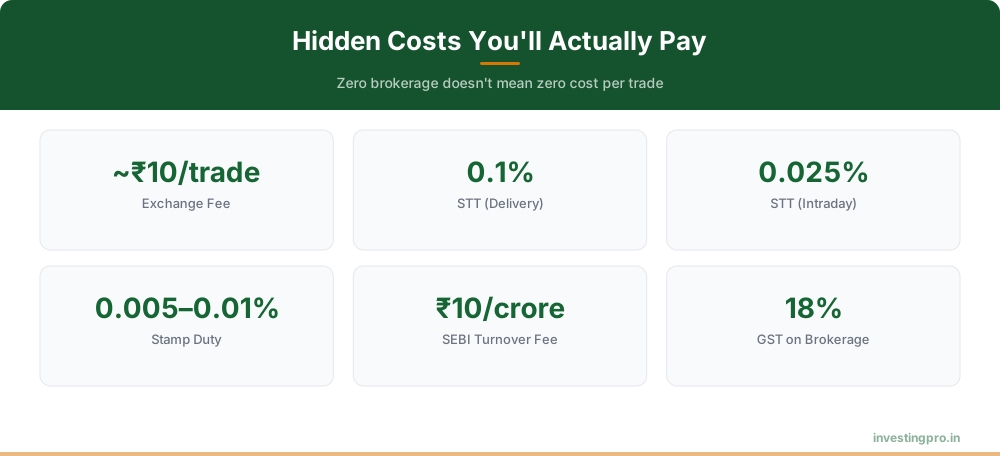
Zero brokerage doesn’t mean zero costs. Here are the hidden fees you need to account for:
- Exchange Fees: Charged by the stock exchange (NSE/BSE) for every trade. Typically ₹10 per trade.
- STT (Securities Transaction Tax): A tax levied by the government on every trade. For equity delivery, it’s 0.1% of the trade value; for intraday, it’s 0.025%.
- Stamp Duty: A state-level tax on the transfer of securities. Varies by state (typically 0.005% to 0.01% of trade value).
- SEBI Turnover Fee: A fee charged by SEBI for regulating the market. Typically ₹10 per crore of turnover.
- GST: 18% on brokerage and other fees.
- Margin Pledge Charges: Some apps charge fees for pledging stocks as collateral for margin trading (e.g., ₹20 per pledge request).
Warning
Always review the fee structure of your chosen app before trading. Hidden costs can add up quickly, especially for high-frequency traders. Use our EMI Calculator to estimate the impact of these fees on your returns.
Security Features: What to Look For
Security should be your top priority when choosing a trading app. Here’s what to check:
- Two-Factor Authentication (2FA): Ensure the app supports 2FA via SMS, email, or authenticator apps like Google Authenticator.
- Biometric Login: Apps like Zerodha, Upstox, and Groww support fingerprint or face ID login for added security.
- SEBI Compliance: Verify that the broker is registered with SEBI and complies with its regulations. Check the broker’s SEBI registration number on their website.
- Data Encryption: Look for apps that use 256-bit SSL encryption to protect your data.
- Nomination Facility: Ensure the app allows you to add a nominee for your demat account in case of unforeseen events.
Always enable 2FA and avoid storing passwords in your browser. Use apps that support UPI-based login for faster access without compromising security.
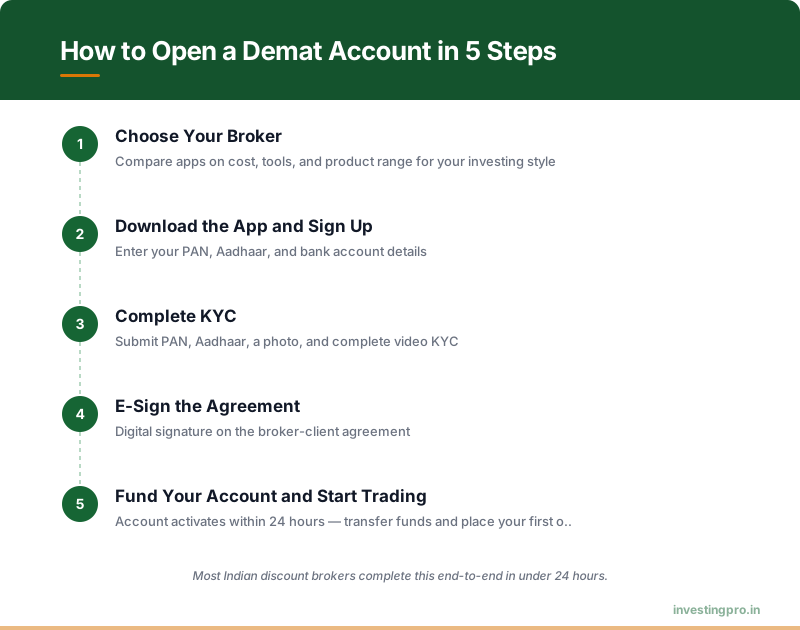
How to Open a Demat Account in 5 Steps
Opening a demat account is easier than ever. Here’s a step-by-step guide:
Step 1: Choose Your Broker
Compare the apps we’ve reviewed and pick one that suits your needs. For beginners, Groww or Paytm Money are great choices. For active traders, Zerodha or Upstox are better.
Step 2: Download the App and Sign Up
Download the app from the Google Play Store or Apple App Store. Click “Open Demat Account” and fill in your details (PAN, Aadhaar, bank account, etc.).
Step 3: Complete KYC
You’ll need to complete your Know Your Customer (KYC) process. This involves:
- Submitting your PAN card, Aadhaar card, and passport-sized photograph.
- Providing your bank account details for fund transfers.
- Completing a video KYC (most apps now support this).
Step 4: E-Sign the Agreement
After KYC, you’ll need to e-sign the broker-client agreement. This is a digital signature process that takes less than a minute.
Step 5: Fund Your Account and Start Trading
Once your account is activated (usually within 24 hours), transfer funds from your bank account to your trading account. You’re now ready to start trading!
Pro Tip
Use the broker’s UPI ID for instant fund transfers. Apps like Zerodha and Upstox support UPI-based deposits, which are faster and more convenient than NEFT/RTGS.
Alternatives to Consider
While Zerodha, Groww, and Upstox dominate the market, here are a few alternatives worth considering:
5Paisa
5Paisa is a discount broker with zero brokerage on delivery trades and ₹20 per order for intraday/F&O. It’s ideal for beginners due to its simple interface and low costs. However, its research and advisory services are limited compared to full-service brokers.
Motilal Oswal
Motilal Oswal is a full-service broker with a 3-in-1 account. It offers strong research reports and advisory services but charges higher brokerage for intraday and F&O trades. Its app, MO Trader, is user-friendly and supports advanced charting tools.
Kotak Securities
Kotak Securities is another full-service broker with a 3-in-1 account. It offers a wide range of products, including US stocks, and charges ₹0 brokerage on delivery trades (for trades below ₹50,000). However, its brokerage for intraday and F&O is higher than discount brokers.
Expert Tips for Choosing the Right App
“Always match the app’s features to your investment style. A beginner should prioritize simplicity and low costs, while an active trader needs advanced charting tools and fast execution. Don’t get swayed by marketing gimmicks—focus on what matters most to you.” — Rahul Jain, SEBI-Registered Investment Advisor
Here are some expert tips to help you choose the right app:
- Test the App Before Committing: Most apps offer a paper trading or demo account. Use it to familiarize yourself with the platform before depositing real money.
- Check Customer Support: Test the broker’s customer support by sending a query via chat or email. If they respond within an hour, it’s a good sign.
- Review the App’s Ratings: Check the app’s ratings on the Google Play Store and Apple App Store. Look for apps with 4+ stars and a large number of reviews.
- Compare Margin Trading Rates: If you plan to trade on margin, compare the interest rates charged by different brokers. Upstox and Zerodha offer competitive rates (as low as 8% p.a.).
- Look for Educational Resources: Apps like Zerodha’s Varsity and Angel One’s SmartMoney offer free educational content. These resources can help you improve your trading skills.
Common Mistakes to Avoid
Here are some pitfalls to steer clear of when choosing a trading app:
1. Ignoring Hidden Costs
Zero brokerage doesn’t mean zero costs. Always review the total cost of ownership, including exchange fees, STT, stamp duty, and GST. Use our FD Calculator to estimate the impact of these fees on your returns.
2. Overlooking Security Features
Never compromise on security. Avoid apps that don’t support 2FA or biometric login. Always enable these features to protect your account from unauthorized access.
3. Choosing Based on Brand Name Alone
Just because a broker is well-known (e.g., ICICI Direct or HDFC Securities) doesn’t mean it’s the best fit for you. Compare fees, features, and user experience before making a decision.
4. Not Testing the App First
Always test the app’s demo version before depositing real money. This will help you understand the platform’s features and identify any usability issues.
5. Ignoring Customer Support
Poor customer support can turn a great app into a nightmare. Test the broker’s response time via chat or email before opening an account.
Future of Stock Trading Apps in India
The stock trading app landscape in India is evolving rapidly. Here’s what to expect by 2026:
AI-Powered Trading
Apps like Upstox and Zerodha are already integrating AI for personalized investment recommendations and automated trading strategies. By 2026, we expect AI to play a bigger role in risk management and portfolio optimization.
Blockchain-Based Trading
Blockchain technology is being explored to reduce settlement times and enhance security. While still in its early stages, blockchain could revolutionize how trades are executed and settled in India.
More Global Markets
Apps like Angel One Global and Kotak Securities already offer US stock trading. By 2026, we expect more brokers to expand their global market offerings, allowing Indian investors to diversify internationally.
Enhanced Regulatory Oversight
SEBI is tightening regulations around brokerage fees, customer protection, and cybersecurity. By 2026, we expect stricter compliance requirements, which will benefit investors by reducing risks.
Final Verdict: Best Stock Trading App in India (2026)
Here’s our data-driven ranking of the best stock trading apps in India as of April 2026:
| Rank | App | Best For | Brokerage | Key Strength | Key Weakness |
|---|---|---|---|---|---|
| 1 | Zerodha | Active Traders & Beginners | ₹0 (Delivery), ₹20 (Others) | Best charting tools & research | No 3-in-1 account |
| 2 | Groww | Beginners & Mutual Fund Investors | ₹0 (All Trades) | Simple interface & zero brokerage | Limited charting tools |
| 3 | Upstox | Active Traders | 0.05% (Delivery), 0.03% (Intraday) | Lowest brokerage for active traders | Slower customer support |
| 4 | Angel One | Long-Term Investors | ₹0 (Delivery), ₹20 (Others) | Strong research & 3-in-1 account | Cluttered UI |
| 5 | ICICI Direct | Long-Term Investors | ₹0 (≤₹50k Delivery), ₹20 (Others) | Trusted brand & 3-in-1 account | Higher brokerage for intraday |
Our Top Pick: For most investors, Zerodha offers the best balance of low costs, advanced features, and reliability. If you’re a beginner or mutual fund investor, Groww is a great alternative. For active traders, Upstox is the most cost-effective option.
Warning
This ranking is based on data as of April 2026. Brokerage fees, features, and user experience can change rapidly. Always verify the latest details on the broker’s website before opening an account. Consult a SEBI-registered advisor to align your choice with your financial goals.
Frequently Asked Questions
Which is the best stock trading app for beginners in India?
For beginners, we recommend Groww or Paytm Money due to their zero brokerage model, simple interfaces, and seamless mutual fund investments. Both apps are ideal for first-time investors who want to start with small amounts.
Are there any free stock trading apps in India?
Yes! Apps like Groww, Paytm Money, and Zerodha offer zero brokerage on equity delivery trades. However, you’ll still need to pay exchange fees, STT, stamp duty, and GST. Always review the total cost before trading.
How do I avoid hidden charges in stock trading apps?
To avoid hidden charges, always review the broker’s fee structure on their website. Look for exchange fees, STT, stamp duty, SEBI turnover fee, and GST. Use our SIP Calculator to estimate the impact of these fees on your returns.
Can I trade in US stocks from India using these apps?
Yes! Apps like Angel One Global and Kotak Securities offer US stock trading. However, you’ll need to comply with RBI’s Liberalized Remittance Scheme (LRS) and pay additional fees like currency conversion charges.
What is the minimum amount required to start trading in India?
There’s no minimum amount to open a demat account, but most brokers require a minimum deposit to start trading. For example, Zerodha requires a minimum deposit of ₹100, while ICICI Direct requires ₹5,000. Check the broker’s website for specific requirements.
Disclaimer
This article is for informational purposes only and does not constitute financial advice. Rates and offers are subject to change. Please consult a SEBI-registered advisor before making investment decisions. InvestingPro.in may earn a commission when you apply through our links.